7 Best Construction Aluminum Profiles for Global Buyers
Construction Aluminum Profiles are rarely chosen by appearance alone. A slim mullion may look elegant in a showroom, but it must also handle wind loads, water exposure, thermal movement, and years of daily use. For global buyers, the right profile depends on the building, climate, fabrication capacity, and installation details. Small choices matter.
The stakes extend beyond the frame. The 2024 Global Status Report for Buildings and Construction, published by UNEP and GlobalABC, estimated that buildings and construction accounted for 32% of global energy demand and 34% of energy-related CO₂ emissions in 2023. Those figures make thermal performance and material selection worth careful review. They do not, by themselves, prove that one profile is always the greener choice. System design and sourcing matter, too.
As architect Carl Elefante, former president of the American Institute of Architects, wrote, “The greenest building is the one that is already built.” That idea is useful when comparing durable new systems with repair or retrofit options. There is no universal winner. Not even close. This guide examines seven widely used profile types, from window and curtain-wall sections to structural and solar-mounting profiles. It considers strength, finish, thermal breaks, fabrication, and application fit. Buyers should also verify alloy and temper documentation, tolerances, coating specifications, and supplier quality controls. A polished sample is only a start. Real project conditions can expose gaps that a catalogue never shows.
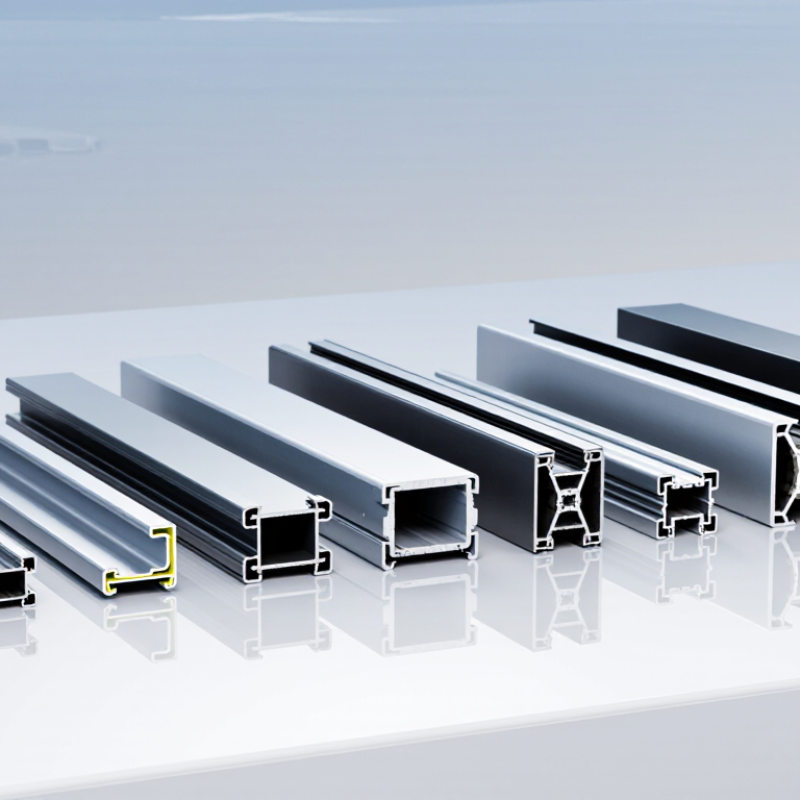
How to Classify 7 Construction Aluminum Profiles by Function and Alloy
Construction profiles are easier to compare by job than by shape alone. The International Aluminium Institute’s Aluminium for Building and Construction briefing identifies buildings as a major aluminium end-use, accounting for roughly one-quarter of global demand. That scale makes alloy choice consequential.
Curtain-wall mullions and window or door frames commonly use 6063-T5 or T6, which suits detailed extrusion and visible finishes. Thermal-break frames add an insulating barrier between inner and outer aluminium sections. Louvers control shade and airflow; their blades often use 6063 alloy. Small details matter. Check drainage paths and coating thickness, not just the profile drawing.
For heavier loads, structural beams and handrail sections may use 6061-T6, subject to engineering checks. Solar mounting rails often use 6005A-T6 or 6063-T6, with selection shaped by span, connection design, and exposure. These seven functions—curtain wall, window and door, thermal break, louver, structural, handrail, and solar rail—are useful buying categories, but not fixed alloy rules. Alloy labels alone can mislead; temper, wall thickness, finish, and fabrication all affect performance. I would verify load tables against the actual support spacing, since catalog examples rarely match every project.
Window, Door, and Curtain-Wall Profiles: 6063-T5 Has 145 MPa Minimum Tensile Strength
For window, door, and curtain-wall systems, 6063-T5 offers a practical balance of strength, formability, and surface finish. A 145 MPa minimum tensile strength is a useful purchasing benchmark, but it is not universal. ASTM B221/B221M lists mechanical requirements by alloy, temper, and product dimensions, so buyers should check the applicable table and test certificate.
Small detail. A slim frame section and a deep mullion do not necessarily share the same limits.
Tensile strength describes resistance to pulling forces; it does not alone predict how a glazed façade performs. Ask suppliers to state the alloy, T5 temper, profile dimensions, and test method, then compare certificates against the project specification. The Aluminum Association’s Aluminum Design Manual also treats alloy properties and member design as distinct checks.
That distinction matters. A profile may meet a tensile threshold yet still need review for deflection, connection loads, and local buckling. In practice, inspect sample corners and screw channels too; thin walls can deform during machining.
One awkward truth: paperwork can look complete while a critical dimension is missing. Verify it before ordering.
Structural Tubes, I-Beams, and T-Slots: 6061-T6 Has 260 MPa Minimum Tensile Strength
7 Best Construction Aluminum Profiles for Global Buyers
Structural tubes, I-beams, and T-slots serve different jobs. Tubes suit frames and posts, while I-beams carry loads across longer spans. T-slot profiles make adjustable workstations and guards easier to assemble. The shape matters. So does the alloy temper. For 6061-T6, a minimum tensile strength of 260 MPa may apply to a specified product standard and size range; it should not be assumed for every profile. Check the applicable standard, dimensions, and material certificate before comparing offers.
Tensile strength describes resistance to pulling, not the full design capacity of a beam or connection. Buyers should also confirm yield strength, wall thickness, straightness, and tolerance. Look closely at cut ends and corners: small burrs can complicate assembly, and thin tube walls can dent under poorly placed clamps. Welding needs extra care. Heat can reduce strength near the weld, so the original T6 value may not describe that area. A practical order check includes alloy and temper identification, measured dimensions, and traceable test documents. One easy-to-miss detail is whether the supplier’s quoted strength matches the actual section thickness. It is worth checking twice.
Thermal-Break and Solar-Mounting Profiles: Compare 14–34 mm Polyamide Barriers
For thermal-break profiles, a 14 mm polyamide barrier can suit compact frame systems, while a 34 mm barrier creates a longer path for heat transfer. Wider is not automatically better. Frame geometry, metal thickness, seals, glazing, and installation all affect whole-window performance. Ask suppliers for tested thermal transmittance values for the complete assembly, not just the strip. A wider cavity can also affect profile stiffness and fabrication, so verify the design before specifying it.
Solar-mounting profiles solve a different problem. Their section shape, alloy condition, and connection details must carry module loads while limiting deflection. Polyamide barriers are generally not the main performance feature in these rails. Instead, compare load-test data, clamp compatibility, drainage, and corrosion protection. IEA’s Renewables 2024 report forecasts nearly 5,500 GW of renewable capacity additions worldwide from 2024 to 2030, with solar expected to provide most growth. That signals a large market, not proof that any profile is suitable.
On a project, check drawings and test certificates against local wind, snow, and span conditions. Small details matter. A rail that looks substantial may still twist at a long cantilever. And a thermal-break width alone cannot predict energy savings; that part is easy to oversimplify.
Construction Aluminum Profiles: Polyamide Barrier Width Options
Representative nominal barrier widths for thermally broken aluminum profiles, from 14 mm to 34 mm.
Wider polyamide barriers can provide more space for thermal separation, but performance depends on the complete profile design and glazing system. These are representative width options, not universal specifications. Standard solar-mounting rails generally do not use polyamide thermal-break barriers; check the profile manufacturer’s specifications for project requirements.
Global Buyer Checks: ASTM B221, EN 755-2, and ISO 7599 AA15 at 15 μm
7 Best Construction Aluminum Profiles for Global Buyers
Global Buyer Checks: ASTM B221, EN 755-2, and ISO 7599 AA15 at 15 μm
ASTM B221 covers extruded aluminum-alloy profiles, while EN 755-2 sets mechanical-property requirements for extruded products. They are not interchangeable checkboxes. Match each document to the specified alloy, temper, product form, and delivery condition. Request batch-linked test certificates, not a generic catalogue sheet. Then check dimensions and straightness against the purchase drawing; neither standard alone resolves every profile tolerance.
ISO 7599 addresses anodic oxidation coatings, not extrusion strength. For an AA15 order, state the 15 μm thickness class and ask how average and local readings are reported. Request the test locations, instrument method, and batch traceability. An eddy-current gauge gives quick readings, but narrow grooves and curved faces can distort results. Check several accessible surfaces, and agree on sampling before production. Finish appearance matters too. Anodizing may reveal alloy or surface variations; a clean-looking sample does not prove uniform thickness. That caveat is easy to miss.