Garage Openers - PFC CONTROLS | Miami, Gate Operators, Sliding Gate, Swing Gate, Intercoms, Turnstiles, Bollards, Barrier gate



10 Best Industrial Digital Cameras for Global Buyers
Choosing the right Industrial Digital Camera can shape inspection accuracy, production speed, and maintenance costs. Global buyers often compare resolution, sensor size, frame rate, interface options, and software compatibility. Yet technical specifications rarely tell the complete story. A camera with impressive pixels may perform poorly under flickering factory lights. Another model may deliver stable images but require costly lenses, cables, or integration work.
This guide examines ten industrial digital cameras for demanding environments, including assembly lines, laboratory systems, machine vision stations, and automated inspection cells. Each option deserves attention for practical reasons, not only marketing claims. We consider image consistency, triggering performance, operating temperature, connectivity, documentation, and long-term supplier support. Small details matter. A reliable connector can prevent hours of downtime. Clear software tools can shorten installation for engineering teams.
Our assessment is based on common machine vision requirements and real-world purchasing concerns. However, no camera suits every facility. Testing with your own lighting, targets, motion speed, and control system remains essential. Some recommendations may appear less attractive on paper. That is intentional. The cheapest model may create integration delays, while the highest-resolution model may exceed actual inspection needs. Buyers should verify current specifications, regional availability, warranty terms, and compliance documents before placing an order. This overview aims to support careful decisions, while recognizing that factory conditions can expose weaknesses that a product sheet cannot show.
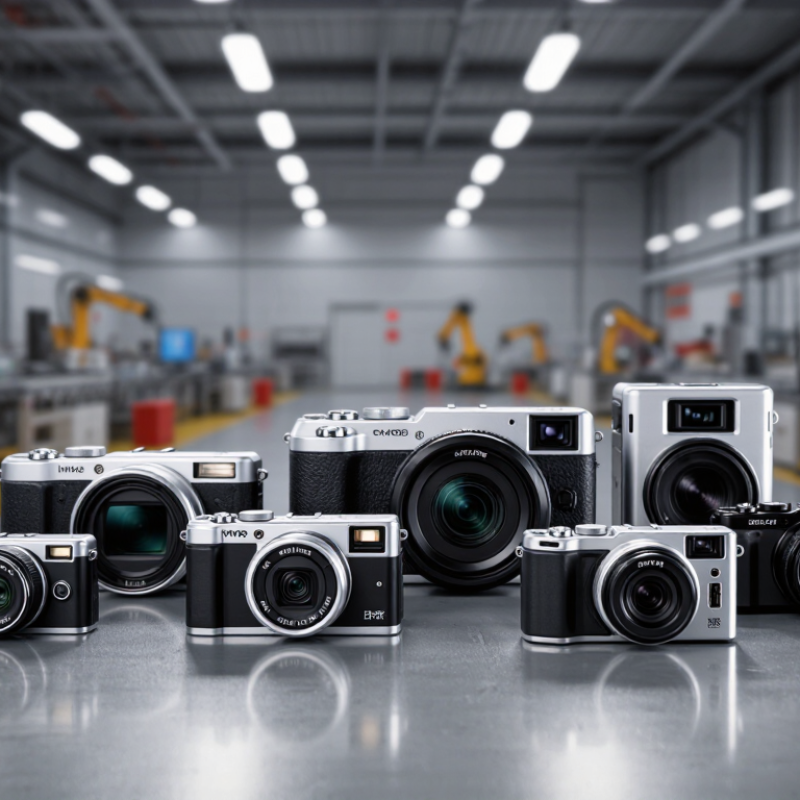
What Defines an Industrial Digital Camera for Global Use
What Defines an Industrial Digital Camera for Global Use
An industrial digital camera must deliver stable images beyond controlled laboratory conditions. Its global value depends on sensor performance, interface compatibility, and long-term reliability. Global-shutter sensors reduce motion distortion on fast conveyors. High dynamic range preserves details in both bright metal and dark cavities. GigE Vision and USB3 Vision support integration across many factory environments.
The International Federation of Robotics reported 541,302 industrial robots installed worldwide in 2023, showing the growing need for dependable visual inspection. A 2024 machine-vision market analysis by MarketsandMarkets identifies inspection, measurement, and identification as major application areas. These figures matter, but they do not replace testing. Check frame rate at the required resolution, not only the headline maximum. Confirm operating temperature, vibration resistance, electromagnetic compatibility, and enclosure protection. ISO 12233 can guide resolution testing, while regional safety and export requirements still need review. A perfect camera does not exist. Overlooking cables, software support, or replacement availability can damage an otherwise strong project.
Tips: Request sample images from your actual materials. Test reflective surfaces, dust, flicker, and changing daylight. Compare five-year support commitments, calibration records, and documentation quality. A cheaper unit may become expensive when integration stalls. Some published specifications also deserve skepticism; independent validation is worth the extra week.
10 Best Industrial Digital Cameras for Global Buyers - What Defines an Industrial Digital Camera for Global Use
| Rank | Camera Profile | Recommended Application | Resolution | Sensor Type | Shutter | Maximum Frame Rate | Interface | Bit Depth | Operating Temperature | Global-Use Advantage |
|---|---|---|---|---|---|---|---|---|---|---|
| 1 | High-Speed 2 MP Area-Scan Camera | Robotics, assembly inspection and fast-moving production lines | 1920 × 1080 | CMOS, monochrome or color | Global | 120 fps | GigE or USB 3.0 | 8/10/12 bit | 0°C to 50°C | High speed, low latency and broad software compatibility |
| 2 | Precision 5 MP Inspection Camera | Dimensional measurement, electronics inspection and quality control | 2448 × 2048 | CMOS, monochrome or color | Global | 60 fps | GigE, USB 3.0 or 5GigE | 8/10/12 bit | 0°C to 50°C | Balanced resolution, speed and data-transfer requirements |
| 3 | High-Resolution 12 MP Camera | Large-field inspection, printed circuit boards and surface analysis | 4096 × 3000 | CMOS, monochrome or color | Global | 30 fps | 10GigE, CoaXPress or USB 3.0 | 10/12 bit | 0°C to 50°C | Captures fine defects while supporting international machine-vision standards |
| 4 | High-Dynamic-Range Color Camera | Automotive parts, packaging, food inspection and variable-light environments | 4096 × 2160 | Color CMOS | Global | 45 fps | GigE or 10GigE | 10/12 bit | 0°C to 50°C | Preserves detail in bright and dark regions with accurate color reproduction |
| 5 | 25 MP Metrology Camera | Precision measurement, semiconductor components and laboratory automation | 5120 × 5120 | CMOS, monochrome | Global | 15 fps | 10GigE or CoaXPress | 12 bit | 0°C to 45°C | Very high spatial detail for applications where accuracy is more important than speed |
| 6 | Line-Scan Camera | Web inspection, roll-to-roll materials, textiles and continuous production | 4K or 8K lines | CMOS or CCD | Global or TDI | 70–100 kHz line rate | CoaXPress, Camera Link or GigE Vision | 8/10/12 bit | 0°C to 50°C | Suitable for unlimited-length objects and high-speed web inspection systems |
| 7 | SWIR Inspection Camera | Moisture detection, material sorting, solar-cell inspection and spectral analysis | 640 × 512 | InGaAs | Global | 100 fps | GigE or Camera Link | 12/14 bit | 0°C to 50°C | Detects wavelengths commonly outside the visible spectrum, approximately 900–1700 nm |
| 8 | Cooled Scientific CMOS Camera | Low-light inspection, fluorescence imaging and research instrumentation | 2048 × 2048 | Scientific CMOS | Global | 30 fps | USB 3.0 or 10GigE | 16 bit | 5°C to 35°C | Thermoelectric cooling reduces dark noise during long-exposure imaging |
| 9 | Rugged IP67 Industrial Camera | Outdoor equipment, logistics, mining and harsh factory environments | 5 MP | CMOS, monochrome or color | Global | 30 fps | GigE Vision with PoE | 8/10/12 bit | -20°C to 60°C | Sealed housing, vibration tolerance and single-cable power and data operation |
| 10 | Compact Embedded Vision Camera | Mobile machinery, smart sensors, kiosks and space-constrained equipment | 2–8 MP | CMOS | Global or rolling | 30–90 fps | MIPI CSI-2, USB 3.0 or GigE | 8/10/12 bit | -10°C to 55°C | Small footprint, low power consumption and easy integration into OEM equipment |
Note: Specifications are representative industry-standard configurations for international machine-vision selection. Actual performance depends on sensor choice, exposure settings, optics, lighting, cabling, software and environmental conditions.