How to Choose the Best Wall Mounted Battery
A wall mounted battery can turn a sunlit roof into evening power, but choosing one takes more than comparing its advertised capacity. The International Energy Agency’s 2024 report, Batteries and Secure Energy Transitions, says global battery storage capacity must rise to around 1,200 gigawatts by 2030 in its net-zero pathway. That figure describes a global transition, not a promise about any household system. Still, it shows why battery performance and reliability matter.
IEA Executive Director Fatih Birol said, “Batteries are changing the game before our eyes, and it is already clear that they will play a major role in the clean energy transitions.” For homeowners, the practical questions are smaller. How much usable energy is available after sunset? Can the battery supply the home’s peak load? Does it work with the existing inverter and solar equipment? A neat casing on a garage wall means little if the system cannot support the appliances you rely on.
Look beyond the headline capacity. Compare usable capacity, continuous power, round-trip efficiency, warranty terms, monitoring tools, and installation requirements. Check the manufacturer’s product documentation, and ask a qualified installer to confirm compatibility and backup performance. Room temperature matters, too; a hot utility space can affect operation and service life. Not every home needs the largest unit. And published figures can be easy to misread. The best wall mounted battery is the one matched to your energy use, site conditions, and realistic backup needs—not simply the one with the boldest specifications.
Understand What a Wall-Mounted Battery Is and How It Works
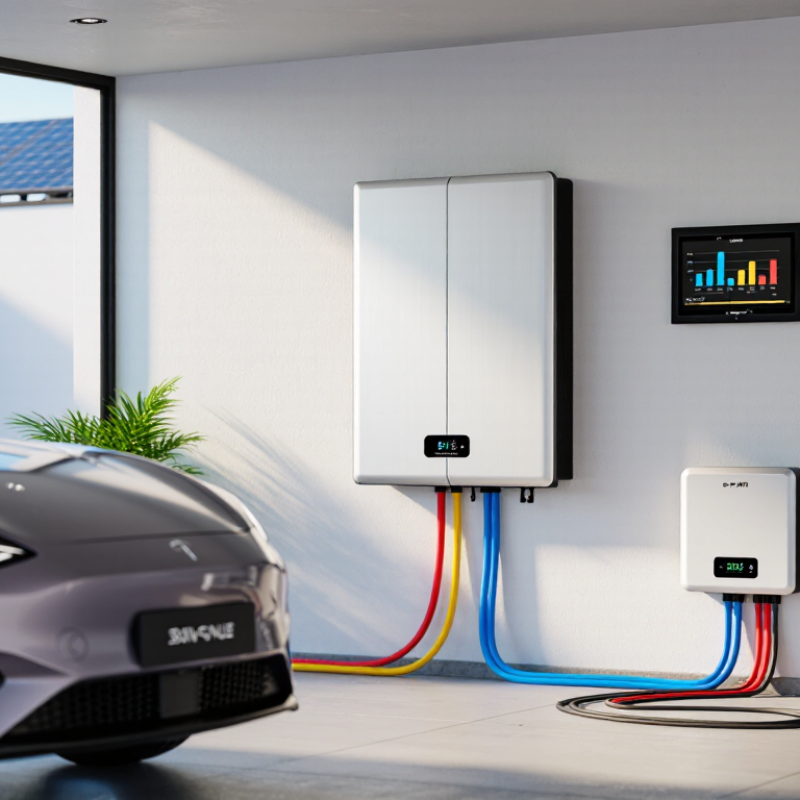
A wall-mounted battery is a rechargeable unit fixed to a wall, often in a garage or utility room. It stores electricity for use later, rather than producing energy itself. Inside, battery cells hold energy as direct current. A control system monitors voltage, temperature, and charging levels to help keep operation within safe limits. It stores power.
When paired with solar panels, the battery can capture surplus daytime electricity for evening use. Without solar, some systems can charge from the grid, depending on their setup. An inverter converts stored direct current into alternating current for ordinary household circuits. During an outage, backup power is available only if the system is configured for it. Not every installation supports whole-home backup.
The details matter. A battery’s usable capacity affects how long it can run selected appliances, while its power rating limits how many can run at once. A refrigerator, for example, may need extra starting power when its compressor switches on. Wall strength, nearby heat sources, clearances, and service access also deserve attention. Estimates can be imperfect; real household use changes from day to day. Check the system’s technical specifications and have a qualified professional assess the installation location.
How a Wall-Mounted Battery Works
A wall-mounted battery stores electricity for later use. In this illustrative household example, solar power runs the home, charges the battery, or is exported during the day. At night, the battery supplies part of the home’s energy demand, and the grid supplies the rest. Values are an example, not product specifications.
Calculate Your Energy Storage Needs and Desired Backup Time
Begin with the circuits you want to keep running during an outage. List each device, its average wattage, and the hours you expect to use it daily. Multiply watts by hours, then divide by 1,000 to estimate energy use in kilowatt-hours. Use measured consumption where possible; a refrigerator’s compressor does not run continuously. Small loads add up.
Add the daily energy for your chosen devices, then multiply it by the number of backup days you want. For example, a 450-watt load running for eight hours uses 3.6 kWh. The battery must supply more than that because inverter losses and reserve capacity reduce what is available to your appliances. Check usable capacity, not just the battery’s headline rating. Also compare peak output with the devices running together, especially motors that draw extra power at startup.
Backup estimates can drift. Cold weather, aging equipment, and longer outages may change the result. I would leave room for those uncertainties rather than size the system exactly to a spreadsheet. That estimate can drift. Revisit the numbers if you add a freezer, medical equipment, or a work-from-home setup. A simple meter and a few days of readings can make the estimate more realistic.
How to Choose the Best Wall Mounted Battery - Calculate Your Energy Storage Needs and Desired Backup Time | Example Backup Scenario | Estimated Loads Running Together | Estimated Average Load | Desired Backup Time | Energy Needed at AC Loads | Approximate Nominal Battery Capacity |
| Essential connectivity and lighting | Refrigerator (150 W average), router (12 W), LED lighting (40 W) | 202 W | 8 hours | 1,616 Wh (1.62 kWh) | About 2.0 kWh |
| Work-from-home essentials | Refrigerator (150 W average), router (12 W), LED lighting (40 W), laptop (60 W) | 262 W | 8 hours | 2,096 Wh (2.10 kWh) | About 2.6 kWh |
| Overnight essentials with a fan | Refrigerator (150 W average), router (12 W), LED lighting (20 W), fan (50 W) | 232 W | 10 hours | 2,320 Wh (2.32 kWh) | About 2.9 kWh |
| Small living area with television | Refrigerator (150 W average), router (12 W), LED lighting (40 W), television (100 W) | 302 W | 6 hours | 1,812 Wh (1.81 kWh) | About 2.3 kWh |
How to calculate: Energy needed (Wh) = total average load (W) × backup time (hours). The battery estimates above allow for 90% usable battery capacity and 90% inverter efficiency: nominal battery capacity ≈ energy needed ÷ 0.81. These are planning estimates, not guarantees; actual consumption and runtime vary. Check the appliance labels or measure actual use, and confirm that the battery and inverter can handle the combined running load and any startup surge. Refrigerator power use varies as its compressor cycles.
Compare Battery Chemistry, Capacity, and Power Ratings
A wall-mounted battery should match the way your home uses electricity, not just look compact on a garage wall. Compare chemistry first. Lithium iron phosphate batteries often favor long cycle life and thermal stability, while nickel manganese cobalt models can offer high energy density. Actual performance varies by design, so check the product specifications and warranty rather than relying on chemistry alone.
Capacity, measured in kilowatt-hours, tells you how much energy the battery can store. Power, measured in kilowatts, describes how quickly it can supply that energy. A 10 kWh battery may run essential loads for hours, but a low power rating could prevent several appliances from starting together. Check both continuous and peak output, then compare them with your inverter and likely loads. A refrigerator, lights, and network equipment need less power than an electric oven or pump. Estimates are imperfect; household use changes with weather and routines.
Tips: Ask for usable capacity, not only nominal capacity. Check operating-temperature limits, round-trip efficiency, and whether the system can expand later. Note where the unit will hang; a sunny, poorly ventilated wall may affect performance. Don’t oversize by guesswork. A qualified installer can review load data and mounting requirements, though the first estimate may still need adjustment after you track real usage.
Check System Compatibility, Installation Space, and Safety Requirements
Choosing a wall-mounted battery starts with the equipment it must work with, not its appearance. Check its chemistry, voltage, usable capacity, and charge and discharge limits against the inverter and system design. Communication matters too: confirm the inverter can read the battery’s data and support its required settings. A mismatch may limit output or prevent operation. Small details matter.
Measure the wall, then allow the clearances specified in the installation manual. Leave room for cables, ventilation, cover access, and future service—not just the battery’s outline. Check that the wall and fasteners can support its weight, especially on older or hollow walls. Keep the unit away from likely water exposure and excessive heat, and make sure required disconnects and protective devices remain accessible.
A qualified installer should verify wiring, grounding, and site conditions before commissioning. Even a careful plan can miss a conduit bend; I would measure twice before drilling.
Space can feel tight once the cables are in place.
Evaluate Warranty, Lifespan, Efficiency, and Total Cost
When comparing wall-mounted batteries, read the warranty beyond its headline number. Check its term, retained-capacity threshold, and any limit on energy throughput. A ten-year warranty may provide less practical coverage if its throughput cap is reached early. Ask whether it covers labor, removal, and replacement, not just the battery unit. Keep the warranty document; small exclusions can change its value. Real conditions matter. Lifespan also depends on temperature, charging patterns, and how often the battery cycles. A cool, ventilated utility room is generally kinder to equipment than a hot, enclosed space. Compare the manufacturer’s stated cycle life with the expected daily use in your home.
Efficiency affects how much stored energy you can actually use. Look for round-trip efficiency, and check that figures use comparable test conditions. A few percentage points may seem minor, but losses add up over years. Then calculate total cost: battery, installation, any required inverter or electrical work, and likely maintenance or replacement. Compare that amount with expected savings using your own electricity rates and usage. I may be cautious, but optimistic savings estimates deserve a second look. Ask for the assumptions in writing, especially expected cycles and usable capacity.