Garage Openers - PFC CONTROLS | Miami, Gate Operators, Sliding Gate, Swing Gate, Intercoms, Turnstiles, Bollards, Barrier gate



How to Choose a Laser Bending Machine in 2026?
Choosing a Laser Bending Machine in 2026 requires more than comparing laser power, tonnage, or catalogue prices. The right decision begins with your parts. Examine sheet thickness, bend length, material mix, daily production volume, and required angle accuracy. A machine shaping 1.5-millimetre stainless steel needs different capabilities from one bending 8-millimetre structural steel.
Market signals support this careful approach. The International Federation of Robotics reported 541,302 industrial robots installed worldwide in 2023, showing how quickly manufacturers are adopting automation. Meanwhile, reports from Grand View Research and MarketsandMarkets identify expanding demand for laser-based metal processing, although their market boundaries and forecasts differ. That difference matters. Industry statistics are useful, but they are not a purchasing plan.
Peter Leibinger, a former TRUMPF technology executive, described the laser as “one of the most important tools of the 21st century.” His observation remains relevant, yet a powerful laser does not guarantee profitable bending. A reliable Laser Bending Machine should combine stable beam delivery, accurate backgauges, real-time angle measurement, intuitive programming, and responsive technical support. Check the details physically: watch a test bend, measure the finished angle, inspect the edge condition, and ask how quickly operators can correct springback.
No checklist is perfect. A cheaper machine may become expensive through setup delays, scrap, or limited service coverage. An advanced model may also be excessive for simple repeat work. This guide compares the practical factors that deserve attention before the final quotation is signed.
What Is a Laser Bending Machine and How Does It Work?
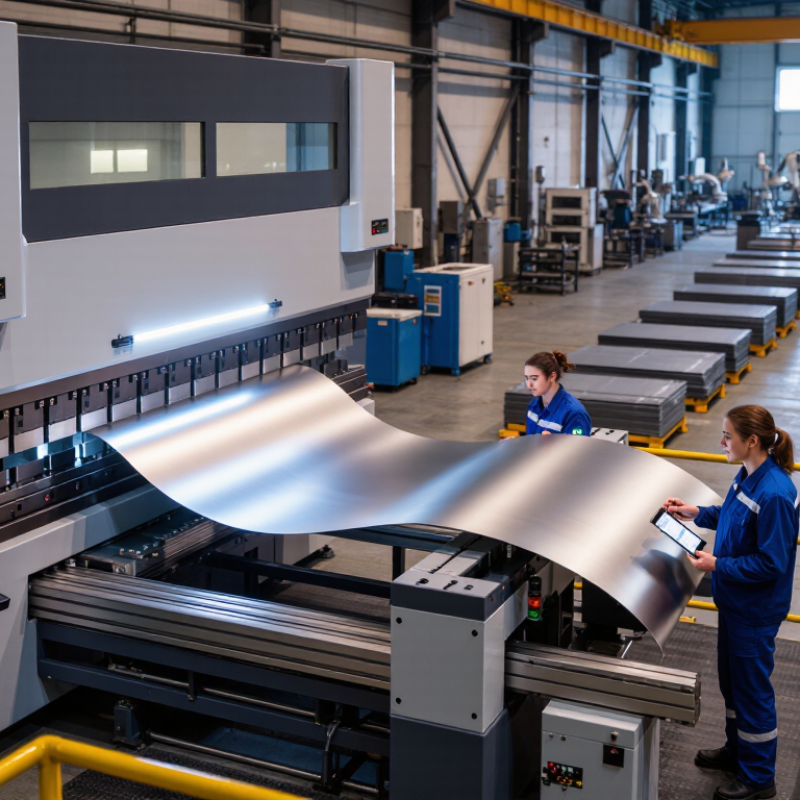
A laser bending machine is often confused with a laser cutting system. In practical manufacturing, it usually means a CNC press brake using laser technology for angle measurement, bend-line projection, or operator safety. The machine clamps a metal sheet between a punch and die. A controlled force then forms the required angle. Laser sensors measure the bend during forming and compare it with the programmed value.
Some systems use focused laser heat to soften a precise area before bending. This method supports delicate materials and complex shapes, but it requires careful heat control. Excessive heat can cause discoloration, distortion, or inconsistent strength. When choosing equipment in 2026, check its working length, tonnage, sensor accuracy, software compatibility, and service support. Test it with your actual material, not only a supplier’s sample. Small differences in thickness can change the final angle.
Tips: Ask whether “laser” refers to measuring, guiding, heating, or safety. Review repeatability data under real workshop conditions. Confirm training, spare parts, and calibration procedures. A faster machine is not always better. Sometimes, simpler controls produce more reliable results. My own evaluation would include repeated bends, because one successful sample proves very little.
How to Choose a Laser Bending Machine in 2026? – What Is a Laser Bending Machine and How Does It Work?
| Evaluation Dimension | Typical Information | What to Check Before Purchasing |
|---|---|---|
| Basic Definition | A laser bending machine is an automated sheet-metal forming system that uses a focused laser to heat selected bend lines and create controlled deformation. | Confirm whether the equipment performs laser forming, laser-assisted bending, or conventional press-brake bending with a laser measurement system. |
| Operating Principle | The laser heats a narrow path on the sheet. Thermal expansion and contraction generate a bending moment, producing an angle without a conventional punch-and-die operation. | Check the control system’s ability to regulate laser power, scanning speed, focal position, and heating patterns. |
| Typical Laser Source | Fiber lasers are commonly selected for their high electrical efficiency, compact design, and low maintenance requirements. Industrial systems may use power levels from approximately 1 kW to several kilowatts, depending on the process. | Match laser power and wavelength to the material, thickness, absorptivity, required heating width, and production cycle. |
| Compatible Materials | Common materials include mild steel, stainless steel, aluminum, and selected high-strength alloys. Material behavior varies with reflectivity, thermal conductivity, and hardness. | Request process trials using the exact grades, surface finishes, thicknesses, and coatings used in production. |
| Suitable Sheet Thickness | Laser forming is generally most effective on thin and medium-gauge sheet. Practical limits depend strongly on material, laser power, bend geometry, and required angle. | Evaluate the full thickness range rather than relying on a single maximum thickness specification. |
| Bending Angle Capability | The achievable angle is process-dependent. Multiple passes, different scanning directions, or preheating may be required for larger angles or difficult materials. | Verify angle repeatability on real parts and identify whether the machine can compensate for springback and thermal distortion. |
| Dimensional Accuracy | Accuracy depends on material consistency, laser stability, motion control, fixturing, heat dissipation, and calibration. Closed-loop measurement can improve repeatability. | Ask for test-part results, measurement methods, calibration intervals, and documented repeatability under production conditions. |
| Processing Speed | Cycle time depends on bend length, material thickness, laser power, scanning speed, number of passes, loading, unloading, and inspection. | Compare complete cycle time, not only laser scanning speed. Include setup, alignment, handling, and quality-control time. |
| Work Area | Available working dimensions vary by machine design. Larger work areas support bigger sheets but usually require more floor space and higher investment. | Select a work envelope that accommodates current parts, future products, fixtures, safety clearance, and material handling. |
| Automation Level | Options may include automatic loading, positioning, clamping, laser path generation, optical measurement, unloading, and production-data collection. | Choose automation according to batch size, labor availability, changeover frequency, and required traceability. |
| Programming and Software | Modern systems may import CAD files, simulate thermal deformation, generate laser paths, store recipes, and connect with manufacturing software. | Check CAD compatibility, offline programming, simulation accuracy, user access controls, and training requirements. |
| Fixturing Requirements | Fixtures must hold the sheet securely while allowing controlled thermal expansion and preventing unwanted movement. | Review fixture changeover time, accessibility, thermal resistance, alignment features, and compatibility with irregular parts. |
| Surface Quality | Laser forming can reduce tool marks because the process does not necessarily require direct punch contact, but discoloration, oxidation, or local heat effects may occur. | Test painted, coated, polished, and protective-film materials to determine whether masking or post-processing is needed. |
| Energy Consumption | Energy use is influenced by laser output power, duty cycle, cooling, motion systems, extraction, and automation. Fiber laser systems are generally more efficient than older laser technologies. | Request measured energy consumption per completed part, including chiller, extraction, controls, and auxiliary equipment. |
| Maintenance Needs | Routine tasks may include cleaning optics, checking cooling circuits, inspecting filters, calibrating sensors, lubricating motion components, and updating software. | Confirm preventive-maintenance schedules, spare-parts availability, remote diagnostics, and local technical support. |
| Safety Requirements | High-power lasers require engineered protection such as enclosed beam paths, interlocked doors, emergency stops, warning indicators, ventilation, and appropriate laser safety controls. | Verify compliance with applicable workplace, electrical, machine, and laser-safety regulations in the installation location. |
| Best-Fit Applications | Typical applications include lightweight enclosures, panels, brackets, aerospace components, architectural parts, prototypes, and low-volume products with complex bend patterns. | Compare the process with a press brake, roll forming, stamping, or manual forming based on volume, geometry, tooling, and tolerance. |
| Total Cost of Ownership | Total cost includes equipment, laser source, cooling, extraction, fixturing, software, installation, training, maintenance, electricity, labor, and downtime. | Calculate cost per acceptable part over the expected service life instead of comparing purchase price alone. |
Note: Performance ranges and capabilities are indicative. Actual results depend on material grade, thickness, geometry, laser parameters, fixturing, machine configuration, and process validation.