What Are Extrusion Shapes Used For?
Extrusion Shapes are profiles formed by pushing material through a shaped opening, creating a consistent cross-section along their length. That repeatable geometry makes them useful in products where parts must fit, support loads, or guide movement. A window frame, for example, may combine narrow channels for glass, drainage, and seals. A machine enclosure might use slotted aluminum profiles to hold panels and accessories. Small details matter.
These shapes appear in construction, transportation, furniture, electronics, and industrial equipment. Their applications depend on material, profile design, and operating conditions. Aluminum is often selected for its low weight and corrosion resistance, while plastic profiles can suit insulation, sealing, or protective trim. Steel may be appropriate where greater strength is required, though added weight and finishing needs can affect the choice. There is no universal profile.
When evaluating Extrusion Shapes, engineers consider dimensions, wall thickness, tolerances, joining methods, and the forces a component must handle. A profile that looks efficient on a drawing may prove difficult to manufacture or assemble. That deserves a second look. Tooling costs, minimum order quantities, and surface finishes can also influence whether a custom shape is practical. Reliable specifications and supplier capabilities should be checked before production. Understanding these trade-offs helps designers choose profiles that serve a clear purpose, rather than adding complexity without a real benefit.
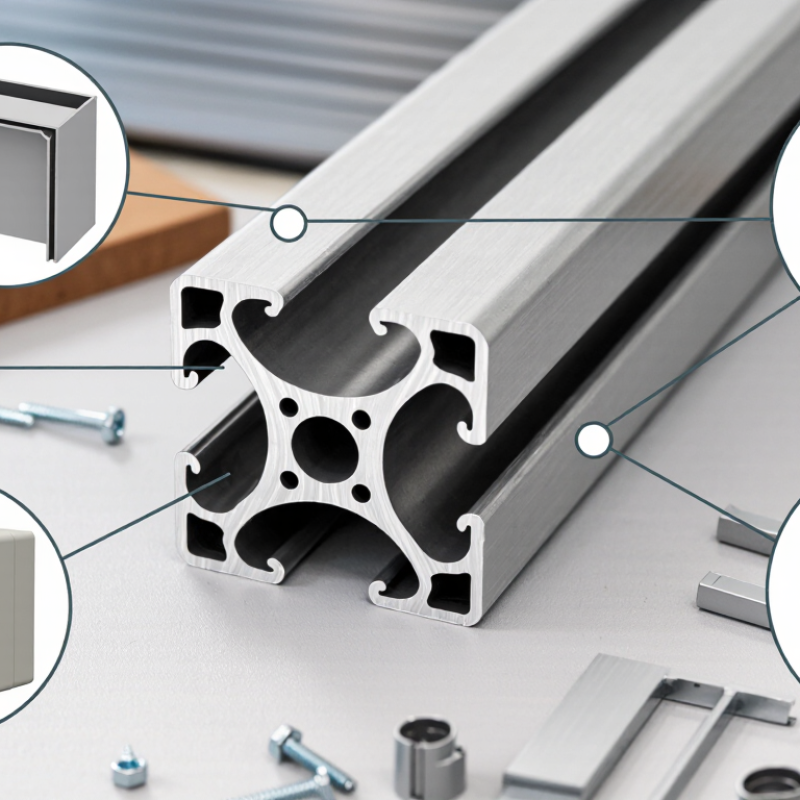
Common Extrusion Shapes and Their Key Properties
Extruded profiles are selected by cross-section, not appearance alone. A solid rod offers straightforward strength and machining, while hollow tubes reduce weight and can carry fluids or cables. Square and rectangular sections stack neatly in frames, shelving, and machine guards. Their flat faces also make fastening easier. But corners can collect stress, so geometry matters.
Channels and angles support edges, brackets, and lightweight structures. An L-shaped angle resists bending in two directions, though it can twist under uneven loads. T-sections help connect panels or divide spaces. Custom profiles can combine grooves, lips, and cavities in one piece. That may reduce assembly steps, but thin walls can distort during production or use. There is no universally best shape; load, span, material, finish, and manufacturing limits all affect the choice.
Tips: Keep wall thickness reasonably consistent, and check corner radii before ordering. Ask for a sample cut. A quick fit test can reveal awkward clearances that drawings miss. Also confirm the intended load with a qualified engineer; a familiar shape is not automatically suitable for every application.
Structural Applications in Buildings and Infrastructure
Extruded shapes turn metal billets into repeatable profiles: rectangular tubes, channels, angles, and custom hollow sections. In buildings, these profiles form window mullions, curtain-wall frames, roof trusses, and canopy supports. A hollow section can provide useful stiffness without a solid block of material. For example, a canopy beam above a station entrance may span between columns while leaving room for drainage and lighting. Small details matter. Designers must check alloy, wall thickness, joints, corrosion exposure, and the full load path; shape alone does not prove structural safety.
Infrastructure uses include pedestrian bridges, transit shelters, sign gantries, and railing systems. Aluminum’s lower density can reduce the weight that foundations or installation equipment must handle, though connection design remains critical. UNEP and GlobalABC’s 2023 Global Status Report estimates that buildings and construction produced 37% of global energy- and process-related CO₂ emissions in 2022. The International Aluminium Institute reports that about 75% of all aluminum ever produced remains in use. These figures make durability and material recovery relevant design questions, not automatic benefits. A poorly detailed extrusion can trap water or fatigue around fasteners. That deserves more attention. Good specifications include inspection access, drainage paths, and clear replacement procedures, especially where maintenance crews face weather and traffic.
What Are Extrusion Shapes Used For? Structural Applications in Buildings and Infrastructure
Aluminum extrusions are used in curtain-wall mullions, window and door frames, sunshades, railings, and selected bridge components. Their strength-to-weight potential makes them useful where reducing structural mass matters. The chart compares typical material properties; values are approximate and normalized to steel.
Reference values: aluminum density ≈ 2,700 kg/m³ and elastic modulus ≈ 69 GPa; steel density ≈ 7,850 kg/m³ and elastic modulus ≈ 200 GPa. Actual properties depend on alloy, temper, and steel grade. A lower modulus also means aluminum members may need careful design for stiffness and deflection.
Uses in Transportation and Industrial Equipment
Extrusion shapes help transportation designers build long, consistent parts with less machining. In buses and rail cars, aluminum profiles can form window frames, seat supports, luggage rails, and interior partitions. Hollow chambers reduce weight while maintaining useful stiffness. That matters when added kilograms affect payload or energy use. Fit still depends on alloy, wall thickness, and connection design.
Commercial vehicles use extruded sections in trailer edges, floor supports, and protective trim. A profile with slots can accept fasteners or panels, which may simplify repairs. But slots can collect grit and moisture. Designers need to consider drainage, corrosion protection, vibration, and impact loads—not just the drawing.
In industrial equipment, extrusions often make machine frames, conveyor rails, workstations, and heat-sink bases. Standard grooves let technicians reposition brackets as layouts change. Useful flexibility. Yet modular frames can loosen under repeated vibration if joints are undersized or poorly tightened. Real installations need load checks and routine inspection; a clean CAD model cannot reveal every rattle, misalignment, or maintenance headache.
Applications in Electronics and Consumer Products
Extruded shapes are useful where electronics need light, repeatable structures with built-in channels. Aluminum profiles often serve as heat sinks, equipment enclosures, monitor supports, and rails. Longitudinal fins increase surface area, while hollow sections can route cables or protect wiring. A laptop dock, for example, may use a slotted profile to support a circuit board and shed heat. One part can do several jobs.
Demand provides useful context, though it does not prove demand for extrusion specifically. IDC reported 1.24 billion smartphone shipments worldwide in 2024, up 6.4 percent from 2023, in its Worldwide Quarterly Mobile Phone Tracker. The Consumer Technology Association forecast U.S. consumer technology retail revenues of $537 billion for 2025. These figures point to a large market for compact devices and accessories. They do not mean every product benefits from an extruded frame.
Extrusions also appear in speaker housings, appliance handles, lighting channels, and adjustable desk components. Designers can specify a profile that fits a product’s width and mounting points, then cut it to length. That can reduce separate brackets. But tooling, finishing, and minimum order quantities affect cost. Not a perfect fit. Thin walls may deform, and a custom shape can complicate repairs. I would check heat flow, load, and access to fasteners before choosing a profile.
How Design Requirements Shape Extrusion Choices
What Are Extrusion Shapes Used For?
How Design Requirements Shape Extrusion Choices
An extrusion profile is more than its outline. Its shape must fit the job, the manufacturing process, and the parts around it. A window frame may need channels for glazing, drainage, and seals. A machine rail may need flat mounting faces and grooves for sliding components. Those details influence wall thickness, corner radii, and the profile’s overall size.
Loads and operating conditions matter too. A lightweight enclosure may use thin walls, while a support bracket needs enough material around its fasteners. For outdoor parts, designers should consider moisture, temperature changes, and surface wear. Tighter tolerances can help parts fit together, but they may also increase production difficulty. Small details count.
A useful design starts with the simplest shape that meets the requirements. Deep, narrow channels or uneven wall sections can make metal flow less consistently through the die. That can affect dimensions and increase the need for adjustments. There is rarely one perfect profile; trade-offs are part of the work. A sketch that looks efficient on screen may be awkward to assemble or inspect. Reviewing a sample section with the manufacturer can reveal those problems before production begins. That step is easy to overlook.