China Top 10 Safety Harness Manufacturers for Global Buyers?
A Safety Harness is a small piece of equipment with a demanding job: helping protect a worker at height when a fall occurs. The International Labour Organization’s 2023 global estimates report nearly 2.93 million work-related deaths and 395 million non-fatal work injuries each year. These figures cover many hazards, not falls alone, but they underline why reliable protective equipment and sound work practices matter. In the United States, the Bureau of Labor Statistics recorded 421 fatal falls, slips, and trips in construction in 2023. The numbers are sobering.
For global buyers assessing China-based manufacturers, a product photo or low quote tells only part of the story. Examine harness design, webbing and stitching, hardware, size range, labeling, traceability, and the manufacturer’s documented inspection and quality-control processes. Ask for current test reports and certificates, then confirm that their scope matches the product and destination market. Standards such as ANSI/ASSP Z359 and EN 361 can guide questions, but a standard name alone does not prove that a specific model complies. Fit matters, too: twisted straps, a poorly positioned dorsal D-ring, or an incompatible connector can undermine a worker’s setup. The following list introduces ten manufacturers for further evaluation, not as a substitute for independent verification. A useful reminder: details matter. I would also look beyond factory claims and ask how design changes, batch records, and customer feedback are handled. That evidence can be harder to assess—and worth asking for.
What Safety Harnesses Are and How They Protect Workers
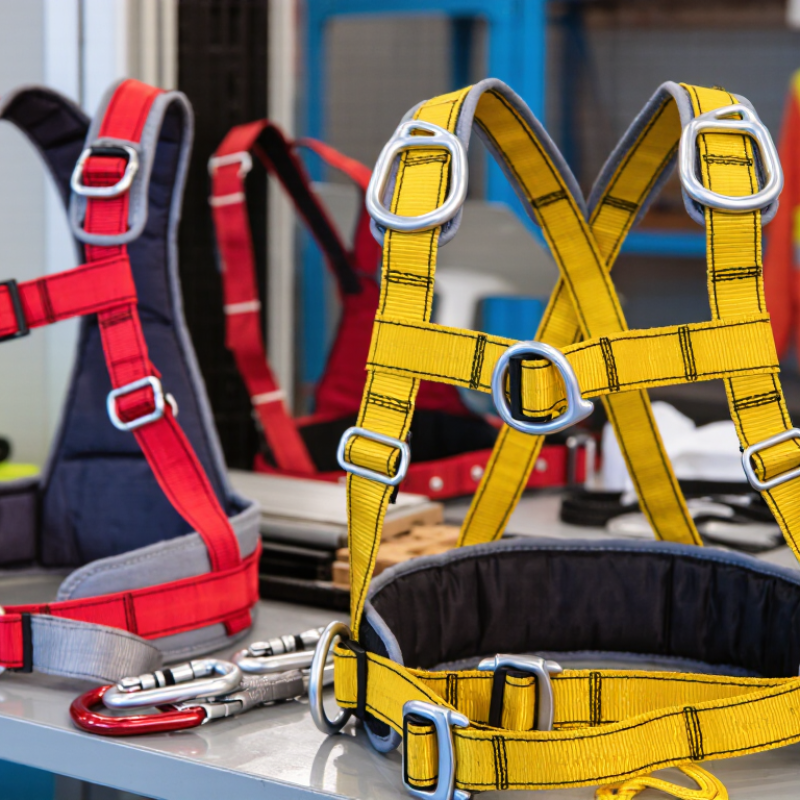
A safety harness is a wearable part of a personal fall-protection system. Most full-body models use adjustable webbing, leg straps, shoulder straps, and a dorsal attachment point. The harness connects a worker to compatible equipment, such as a lanyard or lifeline. On a roof, a worker may clip in before stepping near an exposed edge. The harness does not stop a fall by itself. It helps keep the person connected and spreads arrest forces across the body when used with suitable equipment.
Fit matters. Straps should sit flat, with no twists, and allow movement without slipping off the shoulders. A loose harness can shift during a fall. Too tight, and it may restrict movement or breathing. Small details count. Before each use, workers should check stitching, buckles, labels, and signs of cuts, burns, or chemical damage. Damaged equipment should be removed from service and assessed by a qualified person. The anchor point, connector, and available clearance also need careful review; an obstacle below can still cause serious injury. Training and a practical rescue plan are essential, because suspension after a fall can become dangerous. A harness can feel reassuring, but comfort alone does not prove the system is ready.
China’s Safety Harness Industry and Its Main Product Categories
China’s safety harness industry serves construction, utilities, warehousing, and other work-at-height sectors. Manufacturers produce standard models as well as configurations tailored to particular tasks. A harness may look simple on a product sheet, but webbing width, buckle design, stitching, and attachment-point placement all affect fit and use.
Full-body fall-arrest harnesses are a major category, typically designed to distribute forces across the wearer’s body.
Work-positioning and restraint harnesses support controlled movement or help limit access to fall hazards; they are not interchangeable with fall-arrest equipment.
Suspension and rescue models may include additional attachment points for lifting or retrieval. Some products also use materials selected for demanding environments, such as heat exposure.
Fit matters.
For global buyers, product categories are only a starting point. Compare the intended task, available size range, adjustment points, and compatibility with connecting equipment.
Ask suppliers for clear product specifications, inspection guidance, and test documentation relevant to the destination market. Check the actual labels and stitching samples, not just catalog images. Category names can be misleading, and a small mismatch in fit or configuration may matter on site.
How to Evaluate Safety Harness Manufacturers in China
When evaluating safety harness manufacturers in China, look beyond price and catalog photos. The U.S. Bureau of Labor Statistics reported 885 fatal work injuries involving falls, slips, and trips in 2023. That figure makes consistent product inspection essential. Ask for current test reports for the exact harness model, not a similar product. Check that reports identify the materials, test method, and issuing laboratory. For full-body harnesses, verify relevant requirements such as EN 361 or ANSI/ASSP Z359.11, depending on your market.
Visit the production line if possible. Look closely at stitching near the dorsal attachment point, webbing edges, labels, and buckles. Ask how workers record batch numbers and handle failed inspections. A quality-system certificate can show documented processes, but it does not prove that every harness meets performance requirements. Request sample units and compare their construction with the approved drawings and test reports. A polished catalog can still hide a weak stitch.
Tips: Ask the manufacturer to demonstrate inspection records from a recent production batch. Confirm that the sample, test report, and shipped product share the same model and specifications. Check replacement-part availability and written inspection guidance, too. Small gaps matter. A buyer may overlook these details under deadline pressure; that is worth reflecting on.
Ten Chinese Safety Harness Manufacturers for Global Buyers
For global buyers, comparing ten Chinese safety harness manufacturers is more useful than choosing from a catalog alone. Suppliers may offer full-body harnesses for tower work, construction, or confined spaces, yet designs and production controls can differ. Inspect the stitching around load-bearing points, the adjustment range, and the finish on buckles. Details matter. Ask which model was tested and whether the supplied documents match that exact model.
A reliable review includes sample inspection, clear technical specifications, and discussion with the factory’s quality team. Check webbing labels, serial or batch traceability, and packaging before shipment. Request current test reports and verify their scope with the issuing organization; a certificate for one model does not automatically cover another. Ask to see it. A polished catalog is not proof of consistent production, and a video call cannot replace hands-on inspection. Even a careful shortlist may miss differences between production batches.
Tips: Compare the same harness type and intended use across all ten suppliers. Ask for measurements, material details, inspection records, and sample lead times in writing. Note any answer that stays vague. Then arrange an independent inspection for the shortlisted sample and pre-shipment goods.
How International Buyers Can Verify Suppliers and Manage Sourcing
For global buyers, supplier verification should begin with evidence, not a polished catalog. Request current test reports for the exact harness model, including its configuration and components. Check that the testing laboratory is accredited for the relevant work, and confirm that certificates remain valid. The U.S. Bureau of Labor Statistics reported 885 fatal occupational injuries from falls, slips, and trips in 2023. This broad category is not a count of harness failures. It does show why fit, inspection, and correct use deserve attention.
Ask suppliers to map each product to applicable standards and provide material specifications, inspection records, and batch traceability. Compare the report’s model number with the product label and purchase documents. Small details matter. Inspect a pre-production sample: check stitching, webbing edges, buckles, labels, and D-rings for clear markings and consistent finish. A certificate alone cannot establish that every shipment matches the tested sample.
Sourcing management also needs a practical paper trail. Agree on sample approval, change notification, defect handling, lead-time updates, and incoming inspection criteria before placing volume orders. Review factory capacity and subcontracting arrangements; verify who performs each production step. Keep records by lot, not just by supplier. Price pressure can make these checks feel optional. That is an uncomfortable trade-off, and buyers should revisit it when specifications, materials, or production sites change.
Safety Harness Sourcing: Key U.S. Fall-Arrest Limits
OSHA general-industry requirements set a maximum free-fall distance of 1.8 m (6 ft) and a maximum deceleration distance of 1.07 m (3.5 ft) for personal fall-arrest systems. Use these U.S. limits as a reference when reviewing product documentation; confirm the applicable standards and requirements in the destination market. Source: OSHA 29 CFR 1910.140(c)(13).