Garage Openers - PFC CONTROLS | Miami, Gate Operators, Sliding Gate, Swing Gate, Intercoms, Turnstiles, Bollards, Barrier gate

MENU
Go to content

What Are the Top Types of Battery Powered Pruning Saws?

Choosing the right Battery Powered Pruning Saw starts with the branch, not the product label. A gardener trimming a few thin shoots needs a different tool from an arborist reaching into a mature canopy. Compact handheld mini saws are easy to carry and useful for small branches. Pruning saws with longer bars can handle thicker limbs, but they require a steadier grip. Pole saws extend reach from the ground, reducing the need to climb. They can also feel awkward when the cutting head is fully extended. No single type wins every time.

Tree-care expert Dr. Alex L. Shigo is often credited with the reminder, “A tree is not a pole.” It is a useful thought when choosing a saw: clean cuts and careful branch selection matter as much as cutting speed. Battery capacity, tool weight, chain tensioning, and replacement-chain availability all deserve attention. A light saw may feel comfortable at first, then strain the wrist during repeated cuts. Small details matter.

This guide compares the main types, their best uses, and their trade-offs. It also looks at practical details, such as how easily a saw reaches a branch behind a fence or fits into a crowded shed. Product categories can blur, and advertised cutting capacity does not tell the whole story. Treat it as a starting point, not a promise. The right choice depends on the wood, the reach required, and the user’s comfort with the tool.
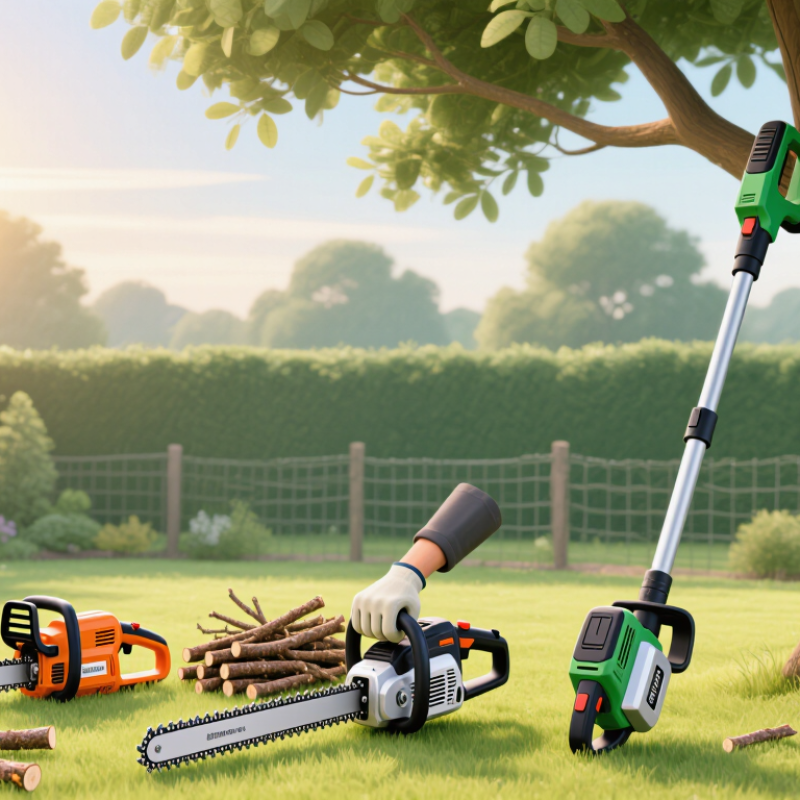
What Are the Top Types of Battery Powered Pruning Saws?

How Battery-Powered Pruning Saws Are Classified

Battery-powered pruning saws are best classified by cutting position, branch size, and battery system—not by one universal industry scale. The 2017 IEC 62841-4-1 standard sets safety requirements for portable chain saws, including electric models, but does not create retail categories. That distinction matters: “mini,” “compact,” and “professional” are often sales labels, not standardized classes.

A practical classification starts with handheld mini saws, commonly using short guide bars for close, controlled cuts on smaller limbs.

Compact two-handed saws offer more leverage for thicker branches and repeated yard work.

Pole saws place the cutting head at the end of an extendable shaft, helping reach overhead limbs while keeping both feet on the ground. Not a perfect boundary: some compact saws accept a pole attachment, so classify by the setup actually used.

Battery voltage and amp-hour rating also help compare tools. Voltage indicates the electrical platform; amp-hours describe capacity, not guaranteed cutting time. Wood species, branch diameter, chain sharpness, and user pressure all change real-world runtime.

In field testing, cut the same dry branch diameter with a sharp chain and a fully charged battery; record cuts and recharge time. Small details count. A wet, knotty limb can drain a pack faster than clean, dry wood.

Handheld Mini Chainsaws for Close-Range Pruning

Handheld mini chainsaws are useful for close-range pruning, where a full-size saw feels bulky. Their short bars can reach crowded branches and make controlled cuts on small limbs. A light tool also puts less strain on your arms during brief jobs. That matters.

For clean cuts, match the saw to the branch, not the other way around. Many mini saws suit limbs only a few inches thick; check the tool’s manual for its limits. Forcing a larger branch can bind the chain or leave a rough tear. Keep it modest. A sharp, properly tensioned chain usually cuts more smoothly than extra pressure.

Before cutting, secure your footing and wear eye, hand, and hearing protection. Keep both hands on the tool if its design allows, and avoid cutting above shoulder height. Watch where the branch may fall, especially when working near fences or other limbs. Battery power is convenient, but charge can fade in cold weather or during repeated cuts. I sometimes underestimate how quickly small jobs use a battery. A spare charge helps, though a pause to inspect the chain is useful too.

Cordless Pole Saws for Reaching High Branches

Cordless pole saws make high-branch pruning possible from the ground, reducing the need to reposition a ladder. A telescoping shaft, balanced battery, and controllable cutting head matter more than maximum reach alone. Check the tool’s rated branch capacity and weight before buying; a saw that feels light at waist height may strain your arms when fully extended. Keep both hands on the grips, stand clear of the falling limb, and never cut near overhead power lines.

The safety benefit deserves perspective. NIOSH’s ladder-safety guidance estimates that more than 500,000 people receive medical treatment for ladder-related falls each year in the United States, with about 300 deaths. These figures cover ladder falls generally, not pole-saw use, but they show why avoiding unnecessary climbs matters. A pole saw does not remove risk: branches can swing unpredictably, and long tools can be difficult to control. One easy mistake is reaching too far instead of moving your feet. For large limbs or uncertain drop zones, call a qualified arborist.

Tips: Test the saw at low height first. Keep a clear landing area, use eye and head protection, and stop if the tool’s weight pulls you off balance. Small limbs only.

Reciprocating Pruning Saws for Controlled Cuts

Reciprocating pruning saws suit controlled cuts where a chainsaw feels too aggressive. Their narrow blade can reach between crowded limbs, and the short stroke helps keep the cut localized. Support the branch near the cut when safe, and let the blade work without forcing it. A sudden change in angle can make the blade wander. Not always.

Choose a pruning blade suited to the branch diameter and wood condition. Check the tool’s rated cutting capacity, then secure your footing and keep the other hand clear of the blade path.

Vibration also deserves attention: European Directive 2002/44/EC sets a daily hand-arm vibration action value of 2.5 m/s² A(8) and a limit value of 5 m/s² A(8). These are exposure benchmarks, not ratings for every saw; consult the tool’s measured vibration data and account for time spent cutting.

Tips: Start with a light touch and a stable blade angle. For a heavy limb, reduce the risk of bark tearing by making a small relief cut before the final cut. Pause if the blade binds, the battery weakens, or your grip becomes tired. A reciprocating saw offers control, but it may cut more slowly than other pruning saw types.

Choosing a Saw Type for Different Pruning Tasks

Choosing a saw starts with the branch, not the tool’s maximum cutting claim. For reachable limbs and repeated cuts, a compact handheld pruning chainsaw is often practical. It can handle thicker wood than many small reciprocating saws, but its weight and moving chain demand steady control. Keep both feet planted and avoid cutting above shoulder height.

Reach matters. A battery-powered pole saw suits high, narrow branches that would otherwise require a ladder. Its longer shaft adds leverage, though, and the cutting head can feel awkward when extended. Make deliberate cuts from a stable position, and allow the branch to fall clear. For occasional light trimming, a compact reciprocating pruning saw may be easier to carry and manage. Its blade can also be useful in tight spaces, but it may cut more slowly through thicker limbs.

Match the saw to typical branch size and how long you work between charges. A larger battery can extend runtime, yet it adds weight. That trade-off is easy to overlook in a store and obvious after twenty minutes of overhead work. I would choose a lighter tool for frequent small cuts, and reserve a pole saw for jobs where reach genuinely improves access. There is no perfect cutoff; wood hardness and blade condition matter, too.

What Are the Top Types of Battery Powered Pruning Saws? - Choosing a Saw Type for Different Pruning Tasks

Saw type How it works Best pruning tasks Reach and cutting range Main advantages Things to consider
Mini cordless chainsaw A compact motor drives a toothed chain around a short guide bar. Removing small branches, cutting back woody growth, and making quick cuts close to the ground. Handheld reach; suited to branches that fit within the saw’s rated cutting capacity. Actual capacity varies by model and wood condition. Compact and maneuverable; can cut faster than hand pruners on suitable woody stems. Requires careful two-handed control where specified, secure footing, and chain maintenance. Not intended for oversized limbs or climbing use.
Cordless pole saw A small chainsaw head is mounted on an extension pole, often with adjustable length. Pruning reachable overhead branches from the ground and thinning the canopy of trees. Extended reach depends on pole length and user height. Cutting capacity depends on the saw head and the branch; follow the model’s instructions. Helps reach elevated branches without a ladder and keeps the cutting head away from the operator. Can be tiring to hold overhead; branches may fall unexpectedly. Keep clear of power lines and the drop zone.
Cordless reciprocating saw with pruning blade A motor moves a blade back and forth; a coarse pruning blade is used for wood. Occasional branch removal, rough cuts, and pruning in confined spots where a chain saw is awkward. Handheld reach; the usable cut depends on blade length, access, and the saw’s capacity. Blade can be changed for different materials, and the tool can serve other cutting tasks with the appropriate blade. May vibrate and produce a rougher cut than a purpose-built pruning saw. Support the branch to reduce blade binding and tearing.
Cordless pruning shear A battery-powered motor closes bypass blades to make a shearing cut. Frequent cuts on smaller stems, shrubs, vines, and fruit-tree growth within the tool’s stated cutting capacity. Handheld reach; designed for smaller-diameter stems rather than saw-sized limbs. Makes repeated cuts with less hand effort than manual shears and is easy to position for precise pruning. Not a saw and not suitable for larger branches. Keep fingers clear of the blades and follow the tool’s safety guidance.
Cordless handheld pruning saw A compact powered saw uses a short reciprocating or chain-driven blade, depending on the design. General garden pruning where a manual saw is slow but a full-size chain saw is unnecessary. Handheld reach; capacity and cutting behavior vary with the blade or bar design and the specific model. Portable and convenient for routine garden work; often easier to maneuver than larger saws. Check the manufacturer’s maximum branch size, recommended grip, and required protective equipment before use.

Selection tip: Match the saw to branch size and working height. Use hand pruners or pruning shears for smaller stems, a handheld saw for accessible woody branches, and a pole saw for suitable overhead cuts made from the ground. Always follow the tool’s manual and wear appropriate protective equipment.

PFC CONTROLS
1638 NW 108TH AVE. MIAMI, FL 33172
Sales: (305) 593-0227
Tech: (305) 546-3965

Copyright, All rights reserved
Back to content